
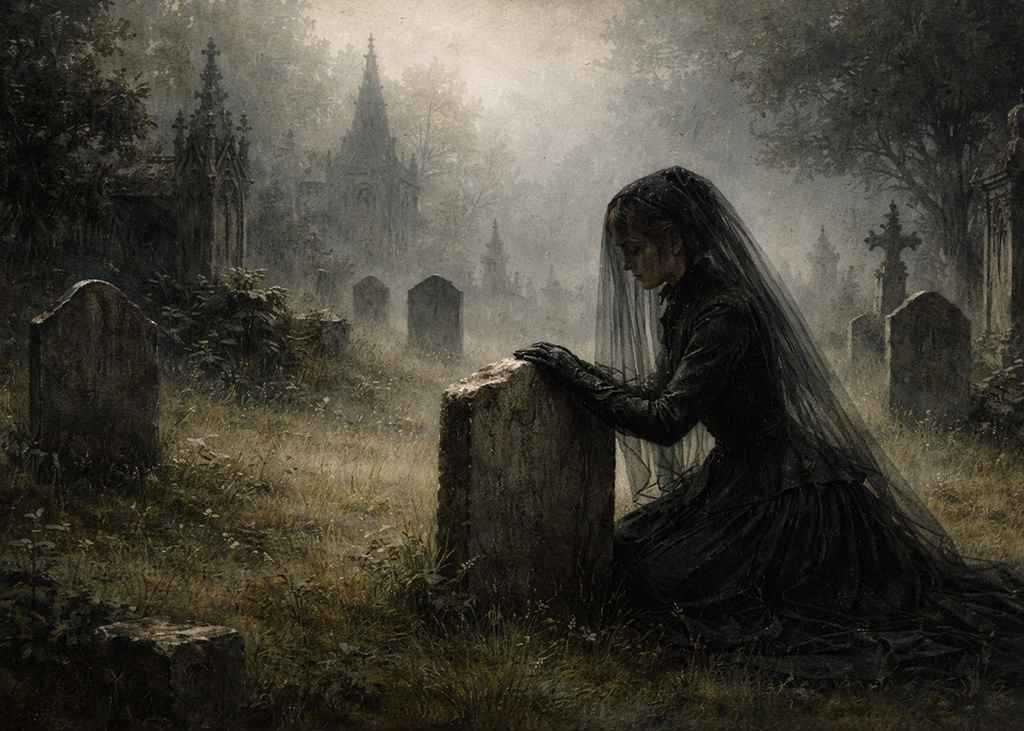
There’s something about grief that horror understands better than almost any other genre. We’ve all heard the platitudes—grief is a journey, it comes in stages, it takes time. But horror fiction? Horror knows that mourning in fiction is also a door. And sometimes, in our desperation to feel close to what we’ve lost, we open doors that should stay locked.
This month, the Spooky Readers Book Club is diving into I’ll Be Waiting by Kelley Armstrong, a paranormal tale about a widow who turns to psychics to contact her late husband. It’s a premise that immediately raises questions: How far would you go to hear a loved one’s voice again? What would you risk for one more conversation? And here’s where it gets interesting, in the world of spooky literature, those aren’t just philosophical questions. They’re the setup for genuine terror.
Mourning in fiction isn’t just an emotion. It’s fuel. It’s the thing that makes rational people do deeply irrational things. It’s what transforms protective parents into monsters, devoted spouses into obsessives, and ordinary mourners into unwitting architects of their own destruction. Let’s explore how different corners of the horror landscape use grief and mourning as the catalyst for truly chilling stories.

When Love Refuses to Let Go: Mourning in Fiction’s Paranormal Side
In Armstrong’s I’ll Be Waiting, we meet a protagonist whose grief has led her down a path many of us might recognize, seeking answers from those who claim to speak to the dead. It’s a gentler entry point into exploring mourning in fiction, paranormal rather than outright horror, but it sets up the central question perfectly: What happens when we can’t accept that someone is gone.
The book explores how grief makes us vulnerable to charlatans, sure, but also to hope. And in horror, hope mixed with desperation is a recipe for disaster. The protagonist’s willingness to believe, to pay, to keep trying to reach across the veil between life and death, reflects something deeply human. We want to believe there’s a way back, even when logic tells us otherwise.

The Price of Resurrection: How Mourning in Fiction Drives Dangerous Choices
If you want to see grief-driven horror at its most devastating, look no further than Stephen King’s Pet Sematary. Here, we have a father who discovers that the woods behind his new home hold a terrible power, the ability to bring the dead back to life. When tragedy strikes his family, his grief overrides every warning, every instinct, every shred of common sense.
King understands that mourning in fiction doesn’t make characters noble. It makes them selfish. It makes them bargain with forces they don’t understand. Louis Creed’s journey is horrifying precisely because we understand it. Who among us wouldn’t be tempted? Who wouldn’t think, just this once, just for my child, the rules don’t apply?
The genius of Pet Sematary is that it doesn’t just punish Louis for his choice, it shows us how grief erodes our ability to learn from mistakes. Even after witnessing the horror of resurrection gone wrong, grief whispers: maybe this time will be different. Maybe love is enough. Spoiler alert: it never is.

Building a Home for Ghosts: Mourning Historical Loss
Jennifer McMahon’s The Invited takes a different approach to depicting mourning in fiction. Here, a woman named Helen becomes fascinated with the history of the land where she’s building her dream home, specifically, with the tragic story of a woman executed for witchcraft centuries ago. As Helen incorporates salvaged materials from old homes into her construction, each piece haunted by its own history, her project becomes less about creating a future and more about resurrecting the past.
What makes this particularly chilling is how grief can attach itself to stories that aren’t even ours. Helen’s obsession with historical loss and injustice becomes a dangerous distraction from her present life. She’s not mourning a personal loss in the traditional sense, but she’s drawn to grief like a moth to flame, collecting other people’s tragedies and weaving them into the walls of her home.
McMahon shows us that sometimes, mourning in fiction isn’t just about who we’ve lost, it’s about the losses we witness, the injustices that haunt us, the deaths that feel unresolved even across centuries. And when we try to provide closure for ghosts that aren’t our own, we risk inviting them into our lives in very literal ways.

When Mourning Opens the Door to Evil: Dark Fantasy Grief
Brom’s Slewfoot takes us to colonial New England, where a young widow named Abitha finds herself alone, unwelcome, and grieving in a harsh Puritan community. Her husband’s death leaves her vulnerable, not just socially and economically, but spiritually. In her isolation and pain, she stumbles into the ancient forest and awakens something old, something that existed long before the colonists arrived with their rigid faith.
This representation of mourning in fiction serves as a gateway. Abitha’s grief creates a crack in her defenses, a moment of vulnerability where ancient powers can slip through. Brom weaves together themes of loss, rage at injustice, and the seductive promise of power to those who have been powerless. The widow’s mourning doesn’t just make her reckless, it makes her powerful in dangerous ways.
What’s fascinating here is how the book explores grief mixed with anger and desperation. Abitha isn’t just sad; she’s furious at the world that took her husband and now threatens to take everything else. That volatile combination of emotions makes her the perfect vessel for forces that feed on chaos and retribution.

Grief as a Monster Magnet: Emotional Vulnerability in Horror
Grady Hendrix’s The Southern Book Club’s Guide to Slaying Vampires gives us something a little different—a vampire story where mourning in fiction manifests not in summoning the dead, but in being unable to see the predator right in front of you. The protagonist, Patricia, is dealing with various losses, the slow disappearance of her identity into her roles as wife and mother, the loss of her father to dementia, the gradual erosion of her autonomy.
When a charismatic stranger moves into the neighborhood, Patricia’s grief and loneliness make her community blind to the danger he represents. Hendrix shows us how grief can make us vulnerable to manipulation, how the need to be seen and valued can override our survival instincts. The vampire in this story doesn’t just feed on blood; he feeds on the emotional gaps grief leaves behind.
The Door Mourning Opens in Fiction
What ties all these stories together is a fundamental truth that horror writers understand instinctively: mourning in fiction breaks down character defenses. It makes them willing to believe impossible things, take unreasonable risks, and ignore glaring warning signs. In the real world, this might mean falling for a scam or making poor decisions. In horror fiction, it means opening doorways to other realms, striking bargains with dark forces, or inviting genuine evil into our lives.
The widow seeking her husband through psychics, the father resurrecting his child, the woman building a house from haunted relics, the desperate widow making pacts with forest gods, the lonely woman unable to see the monster in her midst—they’re all driven by the same engine. They all prove that mourning in fiction isn’t just about what characters have lost. It’s about what they’re willing to do to fill that absence.
These stories resonate because they take our most human impulses—our love, our refusal to accept loss, our desperate hope—and show us the shadow side of those emotions. They remind us that sometimes the most dangerous thing isn’t the ghost or the vampire or the ancient evil. It’s our own unwillingness to let go. When exploring mourning in fiction, horror gives us a safe space to examine these darker impulses and their consequences.
Want to explore more stories where mourning in fiction becomes the gateway to horror? Join the Spooky Readers Book Club for monthly discussions about the books that understand the dark side of human emotion. We meet online each month for lively video chats where we geek out about exactly these kinds of themes. Because sometimes, the best way to process our fascination with fictional darkness is together, in a community of fellow readers who get it.


