
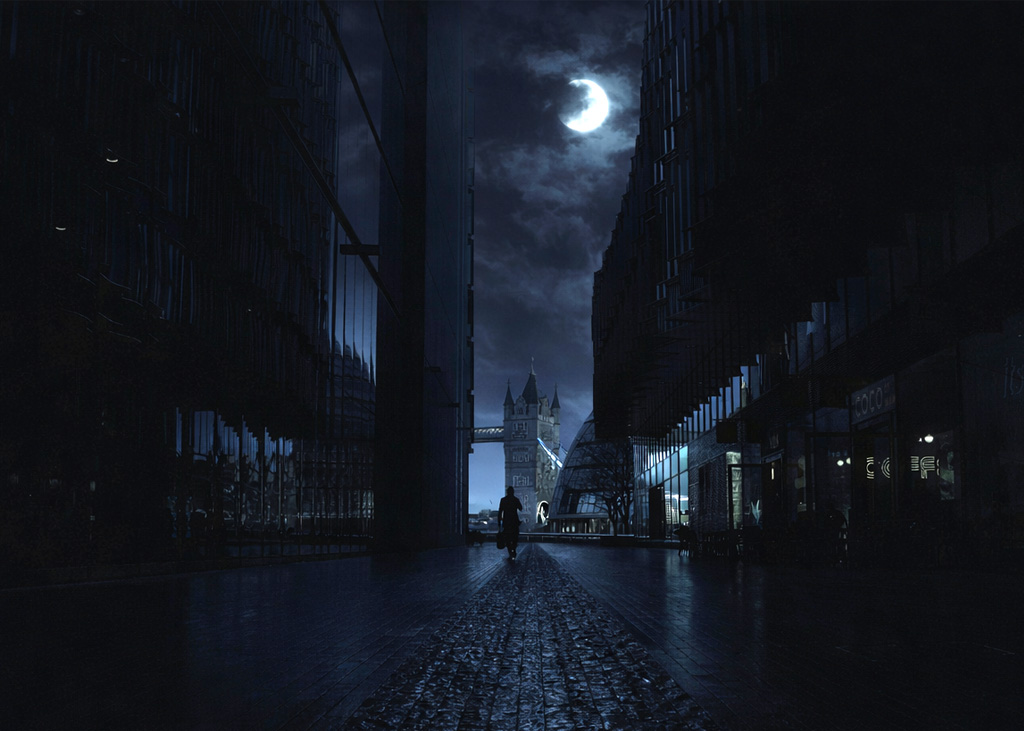
London doesn’t just feel old. It feels like something is still there.
Stand still long enough and the city starts to shift. The present hums along on the surface, but underneath it are older versions of London pressing upward. Roman roads. Plague pits. Buried rivers still running in the dark. Entire neighborhoods that no longer exist except as distortions in the street plan.
It is a city that remembers.
That’s what makes it such a powerful setting for horror. London doesn’t need to be transformed into something frightening. It already contains the structure for it. Hidden spaces, social divides, anonymity, and systems that feel quietly out of control. Urban historians often describe London as a city built on buried infrastructure and . That sense of something lingering just beneath the surface is exactly what horror thrives on.
If you’re looking for memorable spooky books set in London, these stories don’t just use the city. They depend on it.

1. Rivers of London by Ben Aaronovitch
A murder investigation near Covent Garden takes an unexpected turn when Peter Grant interviews a witness who is very much dead.
From there, London opens up in ways it shouldn’t. Magic isn’t hidden away. It’s embedded in infrastructure, paperwork, and long-standing agreements no one fully questions anymore. Rivers have personalities. Jurisdictions extend beyond the visible.
The unsettling part is how normal it all feels. Nothing announces itself. It’s simply been there, operating quietly, waiting to be noticed.

2. The Strange Case of Dr Jekyll and Mr Hyde by Robert Louis Stevenson
In Victorian London, reputation is everything. Appearances are carefully maintained.
Hyde moves through those boundaries without resistance.
He exists within the same city, slipping between its darker streets and respectable spaces with ease. The horror isn’t just the transformation. It’s how easily London allows both versions to coexist.
Nothing breaks. Nothing exposes him. Until it does.

3. Neverwhere by Neil Gaiman
A single act of kindness pulls Richard Mayhew into London Below, a shadow version of the city built from everything that has been overlooked or forgotten. Here, the map stops helping.
Station names become literal. Geography shifts. Safe spaces disappear. The familiar city no longer behaves the way it should.
It’s not that London is hiding something. It’s that it has always had more than one version of itself.

4. 1984 by George Orwell
In this version of London, nothing is hidden because nothing is allowed to be.
The past isn’t buried. It’s erased. Every movement, every thought, every memory is subject to control.
There are no shadows left to hide in. And somehow, that’s worse.

5. Jonathan Strange & Mr Norrell by Susanna Clarke
Magic returns through careful study, polite conversation, and institutional approval.
London becomes the center of that effort. Systems form around something they believe they can understand.
But what lingers beneath it all feels older, less predictable. The city assumes control. It never really has it.

6. The Picture of Dorian Gray by Oscar Wilde
London offers freedom in ways that feel deceptively safe.
Dorian moves through drawing rooms, private clubs, and hidden spaces where reputation becomes flexible and consequences can be delayed. The city gives him access to everything he wants, without forcing him to face what he’s becoming.
That’s where the unease settles. London doesn’t stop him. It makes it easier not to be seen.

7. From Hell by Alan Moore
A graphic novel that re-imagines the Jack the Ripper murders that treats London as something deliberate.
Streets, buildings, and neighborhoods feel arranged, almost ritualistic. Violence doesn’t just happen within the city. It feels shaped by it.
Nothing is random. And once you see the pattern, it becomes impossible to ignore.

8. The Last Days of Jack Sparks by Jason Arnopp
Jack Sparks is a journalist who doesn’t believe in the supernatural, which is exactly why he sets out to disprove it.
What follows is told through his own notes, recordings, and fragmented accounts, all centered around his time in London. The city becomes a backdrop for something increasingly difficult to explain, where digital life, media, and the need to document everything begin to blur with something older and far less predictable.
The unsettling part is how quickly certainty disappears.

9. Kraken by China Miéville
A giant squid disappears from the Natural History Museum, and London begins to unravel.
What follows is less a single mystery and more a collision of hidden systems. Cults, magical factions, and unofficial authorities all emerge at once, each with their own rules and territories. None of it is visible. Until it suddenly is.
Why London Feels So Haunted
By now, a pattern starts to emerge. These books set in London all rely on the same idea. The city doesn’t create something new. It reveals what was already there. Hidden layers become visible. Social divisions become dangerous. Systems begin to slip.
Urban scholars describe London as a “palimpsest,” a place where history is written over but never erased.
If you’re drawn to stories where cities feel alive, where history refuses to stay buried, and where something always feels just slightly off, this is exactly the kind of book that leans into that instinct.
Join the Spooky Readers Book Club and read along with us.


