
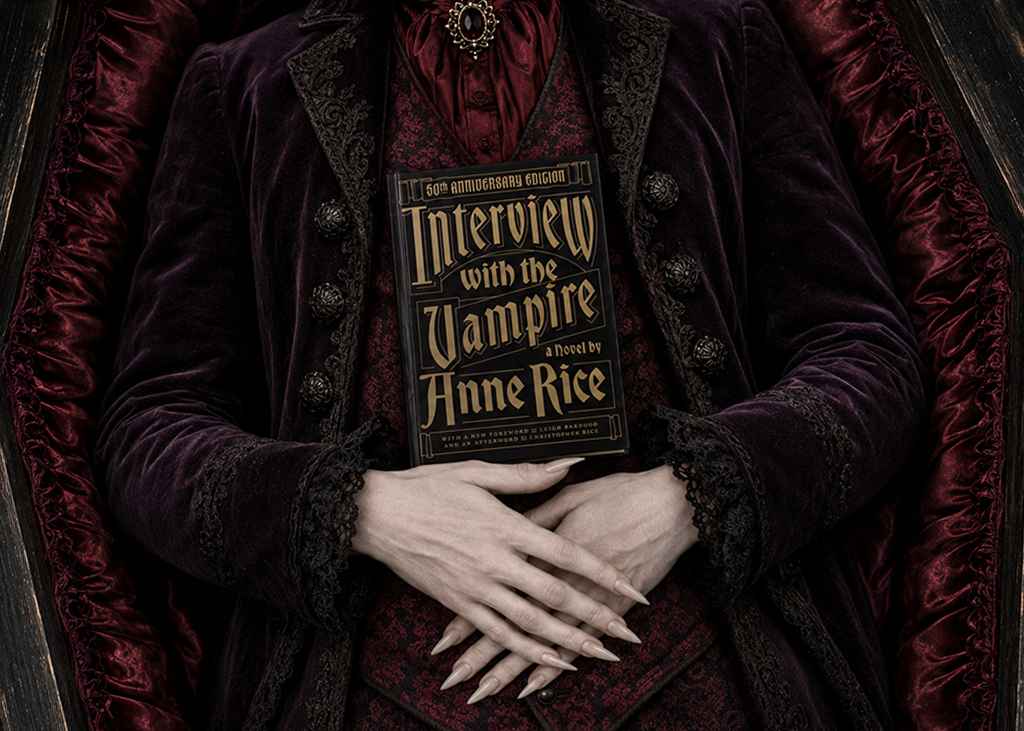
In 2026, Interview with the Vampire turns 50, and somehow Anne Rice’s vampires feel less like relics than returning aristocracy.
A special 50th-anniversary edition of the novel is scheduled for release on October 6, 2026, complete with new material, collector-minded design details, and bonus pages from Rice’s original manuscript. At the same time, AMC is preparing to premiere The Vampire Lestat on June 7, moving its television adaptation deeper into the mythology of The Vampire Chronicles.
That timing feels almost too perfect. Fifty years after Louis first sat down to tell his story, readers and viewers are still willing to listen.
The reason is not simply nostalgia. Interview with the Vampire changed what vampire fiction could do. It did not invent the seductive vampire, the aristocratic vampire, or the tragic vampire. Those figures had already been circling literature for a long time. What Anne Rice did was shift the vampire from the edge of the story to the center of consciousness.
The monster stopped lurking outside the window.
He sat down, looked directly at us, and began to explain himself.
How Interview with the Vampire Changed the Point of View
Before Rice, vampires were usually approached as threats. They might be elegant, erotic, hypnotic, or strangely magnetic, but they were still largely figures to be resisted, exposed, or destroyed.
Interview with the Vampire changed the angle. Louis is not presented as a monster to be hunted. He is the narrator, witness, and the one shaping the story.
That seems normal now because Rice helped make it normal. Britannica describes Rice’s vampires as sympathetic, dysfunctional figures who wrestle with love, loneliness, moral conflict, and the meaning of life. That interiority became one of the great signatures of The Vampire Chronicles.
Louis is not frightening because he is inhuman. He is frightening because he is so recognizably human while still being capable of monstrous things. Louis grieves, desires, and resents. He remembers too much and forgives too little, while craving absolution and control over the story being told.
That is the genius of the interview. It turns horror into testimony.
The reader is placed in the position of listener, and listening becomes dangerous. Louis’s voice is intimate, seductive, and self-serving. He is confessing, but he is also performing. He wants to be understood, but he does not necessarily want to be judged clearly.
That tension still feels modern. We live in a culture built around confession, memoir, public self-explanation, and curated vulnerability. Rice understood something early: the act of telling a story about yourself can reveal as much as the story itself.

Anne Rice Gave Vampires a Family Drama
One of Rice’s most important additions to vampire lore was emotional structure.
Her vampires are not solitary predators drifting through moonlit streets. They are bound to one another through creation, dependence, resentment, desire, and betrayal. The relationship between maker and fledgling is never merely supernatural. It is parental, romantic, coercive, devotional, and sometimes bitterly domestic.
That is why Interview with the Vampire feels less like a simple monster story and more like a very strange family novel.
Louis and Lestat are not just predator and companion. They are locked into a relationship full of attraction, disgust, dependency, and power. Claudia intensifies that dynamic by turning their bond into something even more unstable. She is child, daughter, rival, victim, and avenger, all at once.
Rice’s vampires gave readers a version of immortality that was not lonely because no one else existed. It was lonely because others did exist, and they could never fully give one another what they needed.
That emotional architecture influenced the vampire stories that came after her. Modern vampire fiction often assumes the existence of vampire communities, vampire lovers, vampire families, vampire politics, and vampire grudges. Rice helped build the template.
The Horror of Claudia
Claudia remains one of the most devastating creations in vampire fiction.
The child vampire is a brilliant horror concept because it exposes the cruelty hidden inside the fantasy of eternal youth. Claudia does not simply remain young. She is trapped in the appearance of childhood while her mind continues to develop. Her immortality is not freedom. It is confinement.
Britannica notes that Rice was inspired to write Interview with the Vampire after the death of her young daughter Michelle from leukemia, and that the novel includes a child character who becomes a vampire and stops physically aging.
That biographical context does not reduce Claudia to symbolism, but it does help explain the emotional force of the character. Claudia turns grief into Gothic form. She is beautiful, terrible, loved, wronged, and impossible to resolve.
She also complicates the ethics of vampire creation. To make a vampire in Rice’s world is not simply to share power. It is to impose a future. It is to give someone eternity without their consent and then expect gratitude for the gift.
Through Claudia, Rice makes immortality feel morally contaminated.

Lestat and the Vampire as Performer
If Louis gave Rice’s vampires a confessional soul, Lestat gave them a spotlight.
Lestat is one of the great charismatic monsters of modern fiction because he refuses to remain fixed in someone else’s version of events. In Interview with the Vampire, we see him largely through Louis’s memory. In The Vampire Lestat, Rice lets him answer back.
That act of narrative correction is central to the power of The Vampire Chronicles. The series does not treat history as stable. It treats history as contested. Every immortal has a version. Every memory is shaped by vanity, injury, love, and self-defense.
Lestat’s rock-star turn is one of Rice’s boldest ideas, and it makes perfect sense. He is theatrical by nature and wants an audience. He desires worship, outrage, recognition, and danger. AMC’s upcoming The Vampire Lestat draws from this part of the mythology, with Lestat’s public persona and musical fame at the center of the new season.
But the idea began in the books, and it remains one of Rice’s sharpest pop-cultural instincts. The vampire had long been aristocratic. Rice made him celebrity.
That shift matters. Lestat is not hiding from modernity. He understands it. He uses spectacle the way older vampires used shadows.
The Vampire as Outsider, Lover, and Theological Problem
Rice’s vampires endured because they are never only one thing.
They are erotic figures, but not simply romantic ones. Uniquely monsters, but not only villains. Rice codes them as queer, sometimes makes them explicitly queer, but refuses to let their otherness fit neatly into any single category. Rice’s vampires are wealthy, beautiful, powerful, and doomed. They are also lonely, hunted by memory, and obsessed with the possibility of meaning.
The religious dimension is especially important. Rice’s vampires do not merely ask, “How do I survive?” They ask, “What am I?” and “What does my existence mean?”
Do they have souls? Can they love? Does beauty exist without goodness? Can a creature who kills still long for grace?
These questions are why the books connected so strongly with readers who wanted horror to do more than frighten. Interview with the Vampire offered a monster who could carry grief, philosophy, desire, and spiritual dread without ceasing to be dangerous. Rice’s vampires are compelling because they make moral contradiction feel glamorous, then refuse to let glamour solve anything.
How The Vampire Chronicles Reshaped Pop Culture
The influence of Interview with the Vampire is difficult to overstate because it became part of the air around vampire fiction.
Rice helped popularize the vampire as tortured narrator, romantic antihero, outsider figure, immortal celebrity, and member of a hidden supernatural society. Later vampire fiction did not always imitate her directly, but it often moved through territory she helped define.
Her world also proved commercially durable. Anne Rice’s official bibliography lists Interview with the Vampire as the beginning of The Vampire Chronicles, followed by major entries such as The Vampire Lestat and The Queen of the Damned. Rice’s influence was commercial as well as cultural. Her books have sold more than 150 million copies worldwide, while The Vampire Chronicles remains her best-known and most influential contribution to vampire fiction.
That scale matters because Rice did something horror writers are often trying to do: she made the monstrous intimate enough for readers to return to again and again.
She also helped horror become more porous. The Vampire Chronicles contains Gothic horror, historical fiction, erotic melodrama, religious argument, family saga, and celebrity myth. It is not tidy, and that untidiness is part of its appeal. Rice made vampires feel literary without making them respectable. They remained excessive, hungry, and a little embarrassing in their intensity.
Why Interview with the Vampire Still Matters at 50
Fifty years later, Interview with the Vampire still matters because Rice understood that immortality would not make human longing smaller. It would enlarge it.
Her vampires live too long, remember too much, love badly, forgive rarely, and turn their wounds into myth. Their beauty seduces readers, but their unresolved longings keep them alive on the page.
The anniversary edition and AMC’s renewed attention to Lestat are not just reminders that the franchise is still marketable. They are reminders that Rice built a mythology with unusual staying power. These vampires keep returning because their central questions keep returning.
That may be the lasting brilliance of Interview with the Vampire. Anne Rice did not ask readers merely to fear the vampire. She asked us to listen to him.
And for half a century, we have.
If you like horror that gives you something to think about after the last page, join us at Spooky Readers Book Club. We read eerie, unsettling books together and make plenty of room for smart, spirited discussion.


