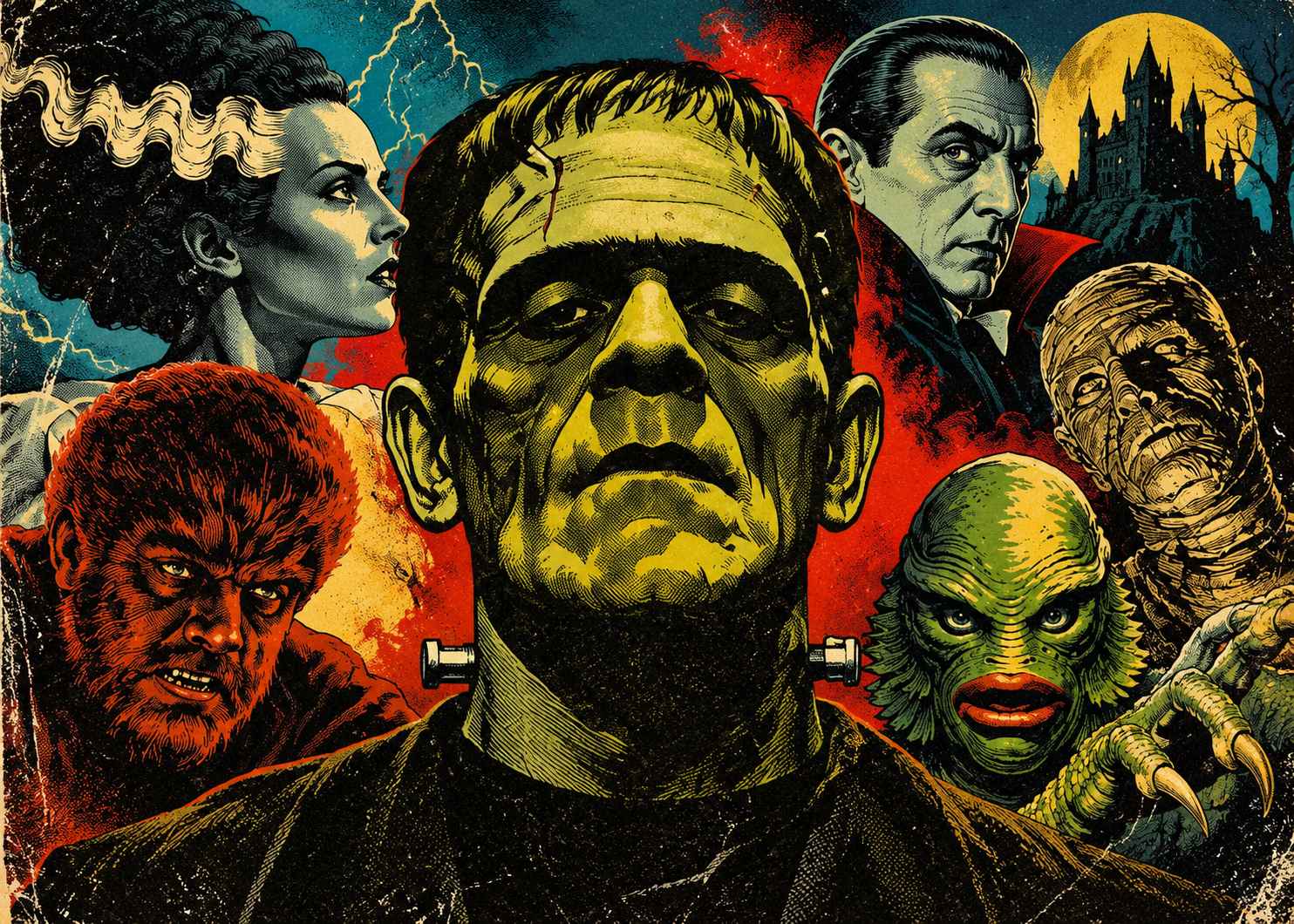
Most people meet the Universal Monsters as images before they meet them as stories.
The Universal Monsters are the classic horror characters popularized by Universal Pictures, especially through its monster films of the 1920s through the 1950s. Although the roster is expansive, the lineup usually includes figures like Dracula, Frankenstein’s creature, the Mummy, the Invisible Man, the Wolf Man, the Phantom of the Opera, the Bride of Frankenstein, and the Creature from the Black Lagoon.
Even if you’ve never seen the movies, the iconography of the films and their characters is still with us today. Dracula raises his cape. Frankenstein’s creature lurches forward with bolts in his neck. The Invisible Man hides behind bandages. The Phantom waits behind the mask. The Wolf Man turns toward the moon. The Mummy rises from the tomb. The Creature from the Black Lagoon glides beneath the water like something the modern world was never supposed to find.
Monsters as Icons
Those images are powerful for a reason. Universal’s classic monster films helped turn older horror stories into a shared visual language, and the studio still groups figures like Dracula, Frankenstein’s Monster, the Mummy, the Invisible Man, the Bride, the Wolf Man, the Phantom, and the Creature together as part of its Universal Classic Monsters collection. With Dark Universe at Universal Epic Universe, these monsters are still being revived, repackaged, and reintroduced to new audiences through theme park spectacle, merchandise, and pop-culture nostalgia. Universal Orlando describes Dark Universe as a world where its legendary classic monsters come to life again.
But the books behind the Universal Monsters are not just old blueprints for better-known movies. They are stranger, richer, and more unsettling than the screen icons suggest.
The films gave these monsters faces, costumes, shadows, gestures, and silhouettes. The books give them voices, ideas, anxieties, and moral complications. That is why they are still worth reading. The movies made them unforgettable. The books make them dangerous again.
A Note on Direct Sources and Literary Companions
Not every Universal Monster comes from one clear source book.
Some do. “Dracula,” “Frankenstein,” “The Invisible Man,” and “The Phantom of the Opera” all have obvious literary roots. “Dr. Jekyll and Mr. Hyde” sits slightly outside the most familiar Universal Monsters lineup, but it belongs in the same literary neighborhood.
Others are messier. “The Wolf Man,” “The Mummy,” and “Creature from the Black Lagoon” were shaped by folklore, earlier fiction, popular anxieties, archaeology, lost-world adventure stories, and Hollywood invention. For those monsters, the books below are best read as literary companions, not direct source texts. They help explain the kind of monster Universal brought to the screen.
In other words, this is not only a list of “books the movies were based on.” It is a reading guide to the stories and traditions that made the Universal Monsters possible.
The Direct Literary Sources Behind Universal Monsters

“Dracula” by Bram Stoker: Read It for the Case File, Not Just the Cape
Bram Stoker’s “Dracula,” published in 1897, is easy to misremember because the movie image became so dominant. The elegant vampire in the cape is now so familiar that it can flatten the book into a simple origin story: here is where Dracula came from.
But the novel is much more interesting than that.
“Dracula” is built like a dossier. Diaries, letters, telegrams, newspaper clippings, ship logs, medical notes, and phonograph recordings all accumulate into a record of something ancient forcing its way into the modern world. The structure matters as much as the monster. This is not just a vampire story. It is a story about people gathering evidence after reality has already been violated.
Universal’s “Dracula” helped define the vampire’s public image: aristocratic, theatrical, hypnotic, and controlled. The book’s Dracula is stranger. He is invasive, animalistic, patient, and difficult to contain. He moves through bodies, borders, species, and social spaces.
Read “Dracula” as a supernatural investigation. The cape may get you in the door, but the book’s real power comes from watching modern people try to understand something older than their tools.

“Frankenstein” by Mary Shelley: Read It for the Creature’s Voice
Mary Shelley’s “Frankenstein; or, The Modern Prometheus”, first published in 1818, may be the most misunderstood book in the Universal Monsters orbit. Pop culture remembers the body: the flat head, the bolts, the heavy boots, the stiff walk. Universal made that image unforgettable.
But Shelley’s creature is not a mute brute. He speaks, reads, learns, argues, suffers, and understands his own rejection with devastating clarity.
That is the reason to read “Frankenstein” now. Not to compare every scene against the movie, but to hear the voice the movie image can obscure. Shelley’s creature is frightening, but he is also abandoned, lonely, intelligent, and painfully aware that the world can only see his body.
Victor Frankenstein is not simply a scientist who goes too far. He is a creator who refuses responsibility. He makes life, recoils from it, and spends the rest of the novel trying to avoid the moral consequences of what he has done.
Universal gave Frankenstein’s creature his iconic shape. Shelley gave him his mind. The book remains powerful because it asks a question the movies can only partly answer: what does a creator owe what he creates?

“The Invisible Man” by H.G. Wells: Read It for Power Without Witnesses
H.G. Wells’s “The Invisible Man”, published in 1897, starts with a fantasy that sounds almost playful. What if a person could disappear?
The book’s answer is not comforting.
Griffin, the scientist who makes himself invisible, does not become free. He becomes worse. Invisibility strips away ordinary consequences, and what remains is ego, cruelty, impatience, and violence. His body disappears, but his character becomes impossible to miss.
Universal’s 1933 film made invisibility cinematic: wrapped bandages, dark goggles, floating objects, empty clothes, and a voice without a face. The movie turns absence into spectacle. The book turns absence into a moral test, and Griffin fails quickly.
Read “The Invisible Man” as a story about power without accountability. It is not scary because invisibility is magical. It is scary because Wells understands how tempting it can be to act when no one can see you.
The Universal Monster version gives us the visual trick. The novel gives us the uglier question underneath: what would someone do if he believed he could never be caught?

“The Phantom of the Opera” by Gaston Leroux: Read It for the Haunted Architecture
Gaston Leroux’s “The Phantom of the Opera,” published in 1910, is often remembered through masks, music, romance, and one very famous face. But the novel is also a Gothic mystery built inside a building that feels almost alive.
The Paris Opera House is not just a setting. It is a machine of secrets. Trapdoors, cellars, hidden rooms, rumors, backstage politics, performances, and underground passages all make the Phantom possible. He is frightening partly because the building seems to belong to him.
Universal’s Phantom tradition helped make the mask and the unmasking central to the character’s legacy. Those images matter. But the book’s deeper pleasure is architectural. It asks readers to move through the Opera House as a space of rumor, obsession, control, and performance.
Read “The Phantom of the Opera” as a haunted-building story as much as a monster story. The Phantom is not only hidden behind a mask. He is hidden inside a system: art, desire, celebrity, secrecy, and spectacle.
The film image gives us the face. The book gives us the house of mirrors around it.

“Dr. Jekyll and Mr. Hyde” by Robert Louis Stevenson: Read It for Respectability Horror
Robert Louis Stevenson’s “Strange Case of Dr. Jekyll and Mr. Hyde”, published in 1886, isn’t usually counted among the core Universal Monsters, though the studio does have a connection to it: Universal released a silent adaptation in 1913, back when the company was brand new. The film most people picture, the 1931 version starring Fredric March, is often mistaken for a Universal classic, but it was a Paramount production. Either way, the story belongs in this reading guide because it gives classic horror one of its most durable ideas: the monster is already inside the respectable man.
Jekyll does not create evil from nothing. Hyde is not an outside invader. Hyde is permission. He is what Jekyll allows himself to become when reputation no longer has to follow him into the room.
That is why the novella still feels sharp. It is not only about transformation. It is about social performance, repression, public virtue, private appetite, and the frightening freedom of escaping consequences.
Classic monster culture often turns transformation into spectacle. Stevenson keeps it intimate and nasty. Hyde is frightening because he is not separate enough from Jekyll.
Read “Jekyll and Hyde” as respectability horror. The monster is not the opposite of the gentleman. He is what the gentleman has been protecting.
Literary Companions for Universal Monsters Without One Source Book

“The Werewolf of Paris” by Guy Endore: The Wolf Man’s Literary Cousin
Universal’s “The Wolf Man” is not a direct adaptation of Guy Endore’s “The Werewolf of Paris”. Larry Talbot is a Universal creation, and the 1941 film helped define the tragic werewolf for generations of viewers.
But Endore’s 1933 novel is a valuable literary companion because it shows how rich the werewolf already was as an idea before Universal gave him his moonlit movie shape.
“The Werewolf of Paris” treats lycanthropy as more than a monster gimmick. It is bodily horror, psychological horror, historical horror, and identity horror all tangled together. The werewolf becomes a figure of appetite, violence, repression, inheritance, and divided selfhood.
That makes it a useful book to read beside “The Wolf Man.” Universal gives us the doomed man cursed by the bite, the moon, and the body that betrays him. Endore helps readers see why that figure works beyond fur and fangs.
The werewolf is frightening because he turns the self into unsafe territory.

“The Jewel of Seven Stars” and “Lot No. 249”: The Mummy Before the Bandages
Universal’s “The Mummy” is also not a straight adaptation of one source novel. It grew out of a larger fascination with Egyptology, tombs, curses, resurrection, museums, imperial collecting, and the fear that the ancient dead might object to being disturbed.
That fascination intensified after the discovery of Tutankhamun’s tomb in 1922, which helped fuel Western Egyptomania. The Metropolitan Museum of Art offers helpful historical context on Tutankhamun and the public fascination surrounding the tomb.
For literary companions, two works matter especially: Bram Stoker’s “The Jewel of Seven Stars”, published in 1903, and Arthur Conan Doyle’s “Lot No. 249”, published in 1892.
These stories help define mummy horror before Universal turned the Mummy into a screen icon. They include archaeology, occult power, mysterious illness, ancient Egypt, resurrection, and the dangerous arrogance of disturbing the dead.
Read them as stories about trespass. The horror is not simply that the dead return. The horror is that the living assumed the dead were theirs to study, own, display, and control.
Universal gave the Mummy his unforgettable cinematic presence. These earlier works show why the tomb was already such a powerful place for horror.

“The Lost World” by Arthur Conan Doyle: The Creature Before the Lagoon
“Creature from the Black Lagoon” is a movie-born monster. There is no single classic novel sitting behind the Gill-man. But Arthur Conan Doyle’s “The Lost World”, published in 1912, is the best literary companion for understanding the kind of story that made the Creature possible.
Doyle’s novel follows an expedition to a remote South American plateau where prehistoric life has survived into the modern age. That structure matters: modern explorers enter an isolated environment and discover that the ancient world is not gone.
“Creature from the Black Lagoon” uses a similar imaginative pattern. Scientists travel into a remote environment. They find evidence of an evolutionary survivor. They enter the unknown with confidence, only to discover that something is already living there and looking back.
The Creature is not frightening because he invades civilization. At first, civilization invades him. That is part of what makes him one of the more sympathetic Universal Monsters. He is monster, discovery, specimen, survivor, and victim of human curiosity all at once.
Read “The Lost World” beside “Creature from the Black Lagoon” to understand the literary grammar of the story: expedition, discovery, arrogance, wonder, and the sudden realization that the map was never complete.
Why Universal Monsters Still Send Us Back to the Books
The Universal Monsters endure because they live two lives at once.
They are instantly recognizable as images: the cape, the bolts, the bandages, the mask, the moon, the tomb, the lagoon. That is the gift of the movies. Universal made the monsters visible enough to travel through posters, sequels, costumes, toys, theme parks, and nearly a century of pop culture.
But the books still matter because they complicate the icons.
The films gave us the monsters we recognize. The books give us the monsters we have to think about.
At Spooky Readers Book Club, this is exactly the kind of haunting we love: stories that move between page and screen, old books that refuse to stay buried, and monsters that still have something sharp under the dust. Join us for our next read, and bring your favorite monster with you.


