
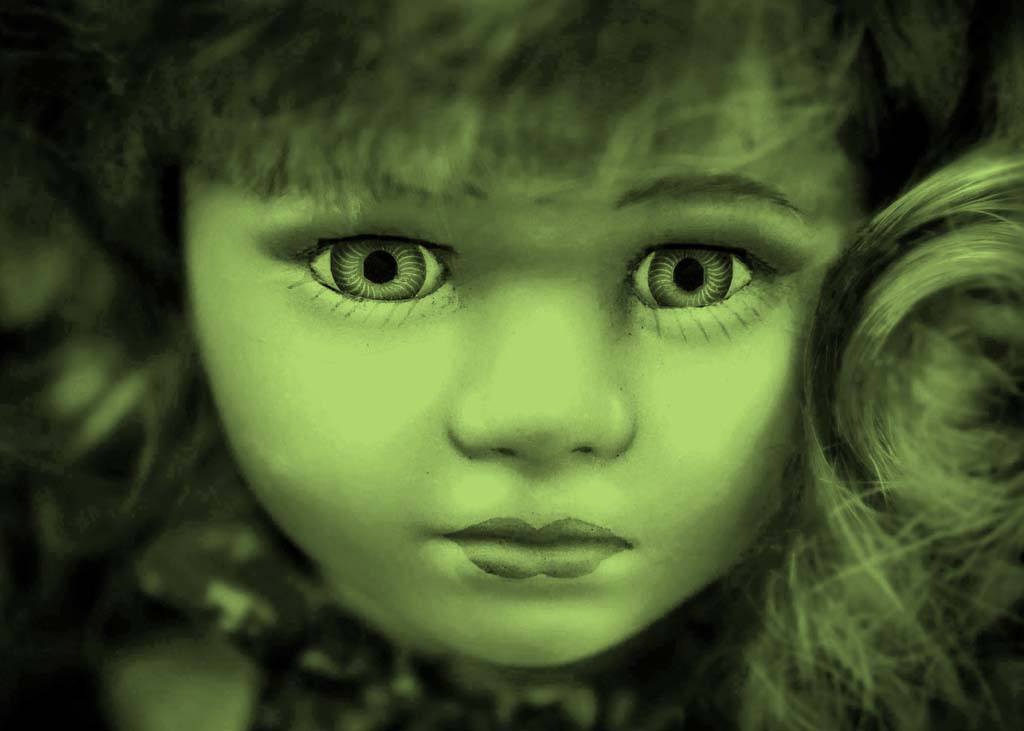
A doll sitting upright in a chair.
A mannequin standing silently in a dark hallway.
A portrait whose eyes seem to follow someone across the room.
Nothing supernatural has happened yet… but something feels deeply unsettling. These moments create a strange, almost hypnotic tension, the kind that makes readers pause and look twice. Writers have long used haunted objects to tap into this eerie feeling because objects that look almost human carry a mysterious and irresistible power in horror stories.
Our current book club pick, The Silent Companions, leans heavily into this idea. The novel features wooden figures that resemble members of the household. They’re technically just decorations. But the more attention they receive, the more unsettling they become.
Why do these objects creep us out so effectively?
Part of the answer lies in psychology. The rest comes from a long literary tradition of writers who understand that sometimes the scariest things in a story don’t move at all.
The Eeriness of Haunted Objects
One useful concept here is the uncanny valley, a strangely fascinating psychological idea. The term was coined by roboticist Masahiro Mori, who noticed that as artificial figures become more human-like, people usually respond positively… until something becomes almost human. At that point the reaction flips, and the figure suddenly feels disturbing, eerie, and oddly lifelike in a way that sparks instinctive discomfort.
Writers figured this out long before psychologists gave it a name.
Sigmund Freud explored a similar idea in his essay “The Uncanny,” where he argued that familiar things become frightening when they feel slightly distorted or unnatural. Dolls and lifelike figures were among his key examples.
In other words, when an object looks too much like a person, it starts to feel like it might have a life of its own.
Perfect material for horror.
Haunted Objects in Classic Gothic Stories
The idea of haunted objects appears throughout Gothic literature, where writers often transform ordinary items into something quietly sinister. A statue, a doll, or a mechanical figure can suddenly become the most mesmerizing and unnerving presence in a story. These objects rarely attack or speak. Instead, their power comes from suggestion, leaving readers with the creeping sense that something about them is not quite natural.
One early example appears in The Sandman. In the story, a young man becomes fascinated with a beautiful woman who later turns out to be an automaton. The moment the illusion breaks is deeply unsettling because the story has been quietly playing with the reader’s perception the entire time.
Another eerie example appears in The Doll, where a man becomes obsessed with a mechanical doll that feels disturbingly lifelike.
Even stories without literal dolls or mannequins often play with similar ideas. In The Turn of the Screw, readers are never entirely sure whether the ghosts are real or imagined. That uncertainty creates the same uneasy feeling that haunted objects often produce.
In each case, the fear comes from ambiguity.
Is the object alive?
Or is the character imagining things?

Why Haunted Objects Work So Well in Horror
One reason haunted objects work so brilliantly in horror is that they don’t need dramatic entrances. They already belong in the room. A doll on a shelf. A statue in a garden. A mannequin standing near a doorway. These quiet objects slowly become ominous focal points, inviting readers to stare a little longer than feels comfortable.
They’re already part of the environment.
A doll on a shelf.
A statue in a garden.
A mannequin in a hallway.
Once a story suggests that the object might be supernatural, readers start paying attention to it in a completely different way.
Did it move?
Was it always facing that direction?
Did its expression change?
Even if the object never actually moves, the possibility alone can create tension.
Folklore is full of objects believed to carry spirits or memories. Dolls, mirrors, and portraits appear in ghost stories around the world. If you want to go down a fun rabbit hole, Atlas Obscura has a fascinating overview of famous haunted objects. Writers have been tapping into this folklore for generations.
When Haunted Objects Start Feeling Like Characters
One of the most intriguing tricks in Gothic fiction is how haunted objects begin to feel like characters. They remain silent and motionless, yet they dominate the emotional atmosphere of a scene. Their presence creates a subtle but intensely suspenseful energy, turning an ordinary room into a place filled with uneasy anticipation.
That’s exactly what happens in The Silent Companions. The wooden figures resemble members of the household so closely that they begin to feel like distorted copies of the living characters.
They don’t need dialogue. They don’t even need to move.
Their presence alone is enough to make readers uneasy every time a character walks into the room.
The tension comes from implication.
Maybe nothing is happening.
Or maybe something already did.

The Fear of Being Watched
Another reason human-like objects feel so unsettling is that they appear to be watching us. Humans are wired to notice faces instantly, and our brains react strongly when something seems to be staring back. Even when we know a doll or mannequin is harmless, that gaze can feel strangely haunting, intimate, and difficult to ignore.
When an object resembles a human face closely enough, that instinct can kick in even when we know the object isn’t alive.
That’s why mannequins, dolls, and portraits appear so frequently in horror stories. They trigger the uncomfortable feeling that someone might be observing us.
And once a story plants that idea, it’s hard to shake.
Reading Haunted Objects Together
Part of the fun of reading horror in a book club is unpacking why certain scenes feel so unsettling.
Why does a doll suddenly seem sinister? Why does a motionless object create tension?
Stories like The Silent Companions remind us that some of the most effective horror comes from simple ideas executed well. A quiet room. A human-shaped object. The lingering suspicion that it might not be as harmless as it looks.
Part of the joy of reading horror together is unraveling why certain scenes feel so chilling and unforgettable. Stories like The Silent Companions remind us that the most brilliantly eerie moments often come from the simplest ideas: a quiet room, a human-shaped object, and the uneasy suspicion that it might not be as harmless as it appears. If you enjoy exploring strange literary themes like haunted objects, our book club is always discovering new stories that spark lively conversations long after the final page.


