
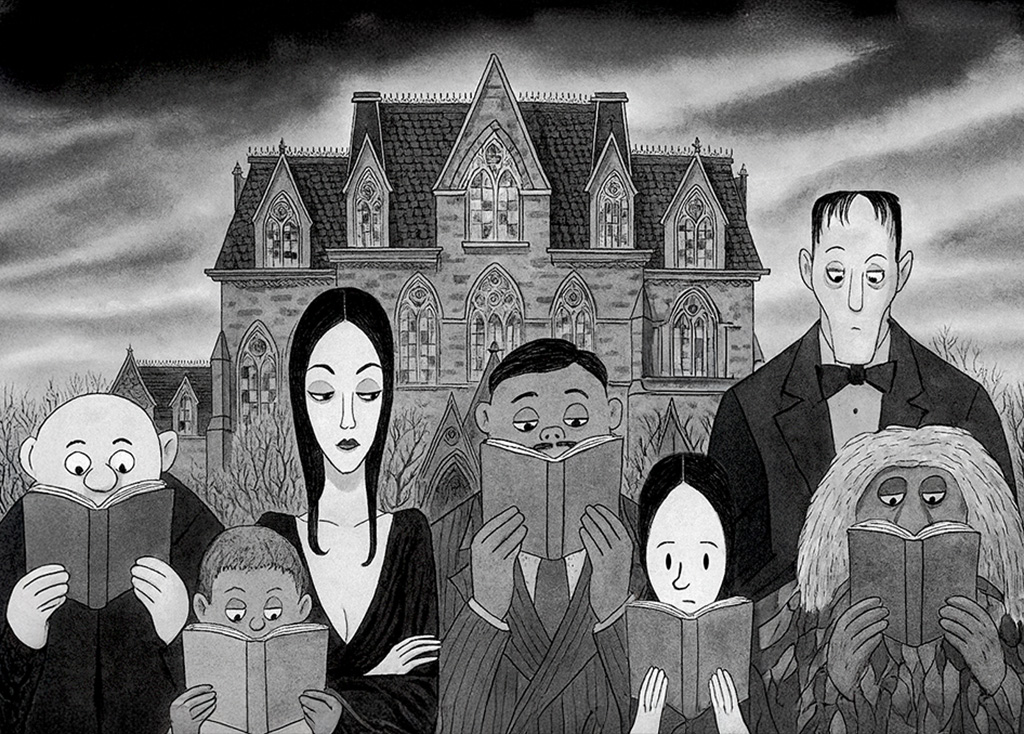
The Spooky Readers Book Club loves the spooky and kooky, so we are thrilled that the new season of Tim Burton’s Wednesday has premiered. It’s the perfect excuse to dig deeper into the eerie literary roots of The Addams Family. While this delightfully morbid family has become a pop culture icon today, their origins and evolution are steeped in Gothic sensibilities, biting satire, and a fascination with the outsider.
The Addams Family’s Origins in Gothic Literature
Before they graced television screens or film sets, the Addamses began life in the single-panel cartoons of Charles Addams for The New Yorker in the late 1930s. These macabre yet witty sketches showed a family at ease in the grotesque, inverting social norms and poking fun at conventional respectability. Without names or formal backstory, the author presents them as archetypes—refined ghouls living cheerfully on the fringes.
Charles Addams drew heavily from Gothic literature and dark humor traditions. Edgar Allan Poe’s shadowed mansions and morbid narrators find their playful reflection in the Addamses’ cobwebbed halls. Mary Shelley’s Frankenstein echoes in the family’s comfort with monsters and misfits, presenting them not as villains but as fully realized beings. Edward Lear’s absurdist poetry and limericks add a whimsical edge, reminding us that morbidity can be mischievous as well as menacing.
How Film and Television Shaped The Addams Family
When The Addams Family transitioned to the 1960s TV series, the characters acquired names, relationships, and emotional depth. Gomez and Morticia became an antidote to the detached sitcom couple: passionately in love, intellectually engaged, and unashamedly eccentric. Wednesday emerged as a proto-Gothic heroine, her sharp intelligence and deadpan wit recalling figures like Jane Eyre or Shirley Jackson’s Merricat Blackwood from We Have Always Lived in the Castle.
The 1990s films amplified these elements, with Christina Ricci’s Wednesday cementing the character’s cultural legacy. Her calm embrace of the macabre resonated with audiences craving unapologetic individuality. These adaptations subtly reminded viewers that Gothic literature is not just about gloom—it’s about finding belonging in strangeness.

Tim Burton’s Wednesday and Its Literary Roots
Netflix’s Wednesday, guided by Tim Burton’s visual style, is perhaps the most literary incarnation yet. Set at Nevermore Academy—a wink to Poe’s “The Raven”—the series envelops Wednesday in a mystery that blends the eerie intrigue of Daphne du Maurier’s Rebecca with the intellectual darkness of Donna Tartt’s The Secret History. Burton transforms Wednesday into a dark-academia sleuth whose typewriter and razor-sharp observations could easily place her alongside classic Gothic detectives.
The show’s themes of alienation, identity, and the search for self are staples of Gothic fiction, repackaged for a YA audience that craves both depth and aesthetic. It’s proof that the Addams legacy thrives when filtered through literature’s timeless preoccupations.
In a broader sense, The Addams Family has encouraged creators to view the outsider not as an object of pity or fear, but as a lens for questioning societal norms. Inverting the haunted house trope—where the “haunted” feel most at home—becomes a metaphor for embracing one’s own peculiarities.
Reading List for the Addams-Inclined
If you’re ready to trace the Addams Family’s literary ancestry, these titles will guide you through their world of elegance, eeriness, and the occasional man-eating plant:
- We Have Always Lived in the Castle by Shirley Jackson
- Wednesday Addams’ blend of intelligence, isolation, and deadpan humor feels very much like Merricat Blackwood, the narrator of this novel.
- Frankenstein by Mary Shelley
- The Addams Family delights in “monsters” and celebrates the strange without judgment — a central idea in Frankenstein.
- The Gashlycrumb Tinies by Edward Gorey
- Gorey’s darkly comedic alphabet of child mortality is tonally in sync with Charles Addams’ humor.
- The Monk by Matthew Lewis
- One of the earliest and most over-the-top Gothic novels, full of excess, scandal, and atmospheric horror.
- Rebecca by Daphne du Maurier
- The story’s atmospheric, brooding mansion, Manderley, is a literary cousin to the Addams mansion.
- Something Wicked This Way Comes by Ray Bradbury
- The dark carnival tale is steeped in small-town eeriness and surreal dread, but with an undercurrent of wonder. It resonates with the Addamses’ blend of childhood innocence and sinister delight — the sense that something strange is not to be feared, but savored.
- The Secret History by Donna Tartt
- This novel’s dark academia aesthetic and mystery align perfectly with Tim Burton’s Wednesday, especially the Nevermore Academy storyline.
Whether you watch Wednesday for the mystery, the morbid humor, or the Gothic flourishes, you’re engaging with a tradition that has been delightfully strange for nearly a century. And here at the Spooky Readers Book Club, we wouldn’t have it any other way.


