
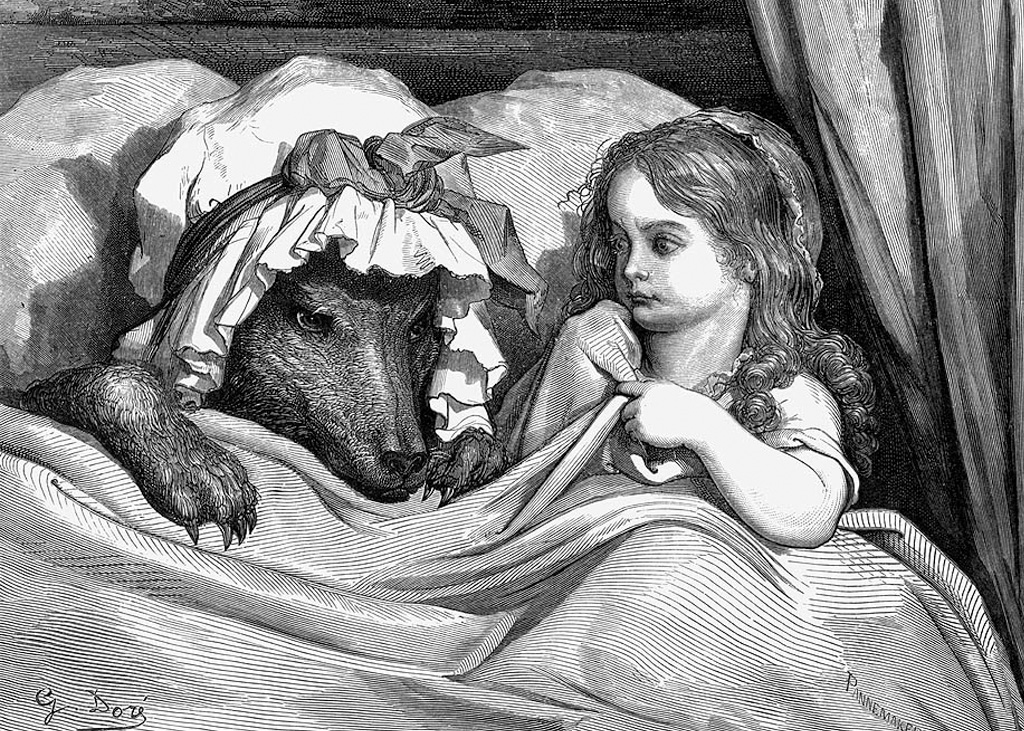
Fairy tales have a reputation problem.
Somewhere along the way, we started treating them as soft things: nursery stories, bedtime rituals, pastel kingdoms, moral lessons tied up neatly with a wedding or a crown. But that version has always been incomplete. Fairy tales were never as innocent as we like to remember. They were full of wolves, bargains, hunger, mutilation, stepmothers, locked rooms, enchanted sleep, and children left in the woods.
The modern fascination with dark fairy tales is not really a trend. It is a return.
Writers are not making fairy tales strange by adding horror to them. They are recognizing the strangeness that was already there.
That’s part of what makes Maria Adelmann’s “How to Be Eaten” such an interesting read for the Spooky Readers Book Club. The novel reimagines familiar fairy tale figures as modern women in a support group, reckoning with trauma, media spectacle, and the stories other people have told about them. Its publisher describes it as a darkly funny novel about classic fairy tale characters as modern women processing trauma, which gets at the book’s real project: not just retelling old stories, but asking what happens to the people forced to live inside them.
Fairy Tales Were Always Darker Than We Remember
People have considered fairy tales primarily children’s stories only relatively recently, compared with the stories’ long history. Fairy tales grew out of oral storytelling traditions, literary salons, folklore collections, and printed books, shifting shape as they moved across cultures and audiences. The British Library’s work on fairy tales points to their oral storytelling origins and their long history across traditions, including French stories by Charles Perrault, the Brothers Grimm, and folk tales from around the world.
The Library of Congress also notes how deeply embedded figures like Mother Goose and fairy-tale traditions became in literary culture, especially through works associated with Charles Perrault’s seventeenth-century “Tales of Mother Goose.”
People kept evolving fairy tales, revising, softening, sharpening, translating, moralizing, and repackaging them. Some versions leaned toward instruction or entertainment, while others were were frankly brutal. What remained constant was their ability to make ordinary fears feel archetypal.
A child fears abandonment. A fairy tale sends them into the woods.
A young woman fears marriage as a trap. A fairy tale gives her Bluebeard.
A family fears hunger. A fairy tale builds a house out of sweets and puts a witch inside.
That is the power of dark fairy tales. They take private dread and make it symbolic enough to survive for centuries.
Why Dark Fairy Tales Still Work on Adult Readers
Adults often return to fairy tales expecting nostalgia and find something more complicated waiting there. The stories feel familiar, but not always comforting. They carry the old logic of childhood, where rules dictate everything, children see adults as dangerous, food always means something more, and a closed door exists mostly to invite opening.
That is why fairy tale horror works so well. It uses recognition against us.
We know the shape of the story, or we think we do. We recognize the girl in the red cloak, the beast in the castle, the forbidden room, the sleeping girl, the hungry witch, the impossible bargain. That recognition lowers our guard. Then the retelling asks a sharper question: what did this story mean before it became decorative?
Angela Carter understood this better than almost anyone. “The Bloody Chamber” is often discussed as a landmark in feminist fairy tale writing, but Carter resisted the idea that she was simply writing “adult” versions of fairy tales. Royal Holloway’s teaching materials quote Carter explaining that her intention was not to write “versions,” but to extract the latent content from traditional stories and use it as the beginning of new ones.
That phrase, “latent content,” is useful. It suggests that we do not need to invent the darkness in fairy tales; we only need to notice it.
In Carter’s work, the old stories become more explicit, but not necessarily more violent than they always were beneath the surface. Desire, danger, wealth, marriage, appetite, and power were there from the beginning. Carter simply refused to leave them politely disguised.

The Familiar Story Becomes a Trap
Fairy tales’ built-in patterns make their dark retellings so effective. Three tasks. Three sisters. A command broken. A promise made. A test failed. A stranger at the door. A path through the woods. Patterns are comforting until they start to feel inescapable.
That’s where a book like “How to Be Eaten” cuts especially deep. Adelmann is not simply asking, “What if fairy tales happened today?” She is asking what it would mean to survive a story everyone thinks they already understand. Publishers Weekly described the novel as invoking classic and modern fairy tales to portray a group of traumatized women, which captures the way the book treats fairy tale survival as something messy, public, and unresolved.
The women in these stories are not just characters. They are symbols people have consumed. That consumption is part of the horror. A fairy tale can flatten a person into a lesson: be obedient, be clever, be beautiful, be careful, do not talk to wolves, do not open the door, do not want too much.
Modern retellings push back by asking what those lessons cost.
For readers who like that angle, “The Bloody Chamber” remains essential. “In the House in the Dark of the Woods” by Laird Hunt offers another brambly, unsettling path into fairy-tale logic, one where colonial history, witchcraft, and dreamlike violence blur together. Helen Oyeyemi’s “Boy, Snow, Bird” uses Snow White as a starting point for questions about beauty, race, family, and concealment. Cassandra Khaw’s “The Salt Grows Heavy” turns mermaids and plague doctors into something stranger and bloodier than most sanitized fairy-tale traditions would allow.
These books work because they understand that a retelling should not just change the costume. It should change the pressure.

The Woods, the House, and the Locked Room
Certain fairy tale spaces keep returning because they hold so much symbolic charge.
The woods are where social rules weaken. The house is where safety turns conditional. The locked room is where curiosity becomes dangerous. The castle is a promise and a prison. The path is never just a path.
The British Library’s fairy tale exhibition materials describe a journey from the cozy cottage into the “deep dark woods,” where visitors encounter heroes and villains from tales such as “Little Red Riding Hood.” That movement from domestic warmth into forest danger is one of the oldest and most durable fairy-tale structures.
Everyone knows what it means to leave the known world and enter a place where the rules change. Fairy tales literalize that experience. Horror intensifies it. The door closes. The path disappears. The house rearranges itself around your fear.
This is why dark fairy tales pair so naturally with horror. Both genres understand that settings are never neutral. They are tests. They reveal what characters want, what they fear, and what they are willing to trade.
Dark Fairy Tales and the Question of Survival
The phrase “happily ever after” has always done a suspicious amount of cleanup. It tells us the story is over, the threat has passed, the moral has landed, and the world has been restored. But many modern dark fairy tales are interested in what happens after the ending. What does survival look like after the wolf, the witch, the husband, the curse, the bargain?
That question sits at the heart of “How to Be Eaten.” Its fairy tale women are not frozen in the moment of symbolic victory or suffering. They have to keep living. They carry memory, public judgment, and the exhaustion of being turned into a story.
That may be why adult fairy tale retellings feel so alive right now. They meet readers who already know that surviving something does not automatically make it meaningful. Sometimes the story people tell about what happened to you becomes another thing to survive.
Fairy tales have always known that the world can be arbitrary and cruel. Modern writers add another layer: so can the narratives we inherit.

Why We Keep Returning to Dark Fairy Tales
Fairy tales last because they are flexible. They can become children’s stories, horror stories, feminist revisions, psychological case studies, fantasy adventures, or literary experiments. They survive by changing. But the darkness is not an accessory. It is part of the engine.
The hunger, danger, bargains, transformations, and forbidden rooms are not accidents. They are the reason the stories keep working. Fairy tales give shape to fears that are otherwise hard to name: abandonment, desire, aging, violence, family betrayal, social obedience, and the terror of wanting more than you are allowed to want.
That is why we keep going back. Not because the stories are safe. Because they never were.
At the Spooky Readers Book Club, this is exactly the kind of story we love discussing: familiar on the surface, stranger the closer you look, and full of old shadows that still know how to move. Join us for our next read, and bring your favorite dark fairy tales with you.


